A kitchen renovation in Lakewood usually starts with one decision that shapes every other choice in the room: the countertop. Cabinet colors, backsplash tile, and even lighting tend to get selected around whatever surface sits on top of the island and perimeter cabinets. For a city built almost entirely between 1950 and 1953, where the median home dates back to 1957 according to U.S. Census figures, that decision often means balancing a mid-century floor plan with materials that didn’t exist when the house was framed.
Granite still holds the largest share of the national countertop market at roughly 28 percent as of 2025, according to Grand View Research. Quartz is closing the gap fast. The National Kitchen & Bath Association’s 2026 Kitchen Design Trends report found that 78 percent of surveyed design professionals expect quartz to be the material homeowners request most often over the next three years. That shift shows up in showrooms across Los Angeles County, including projects in Lakewood, where ranch-style homes on lots near Lakewood Boulevard and South Street are being updated one room at a time.
What’s Driving Countertop Choices Right Now
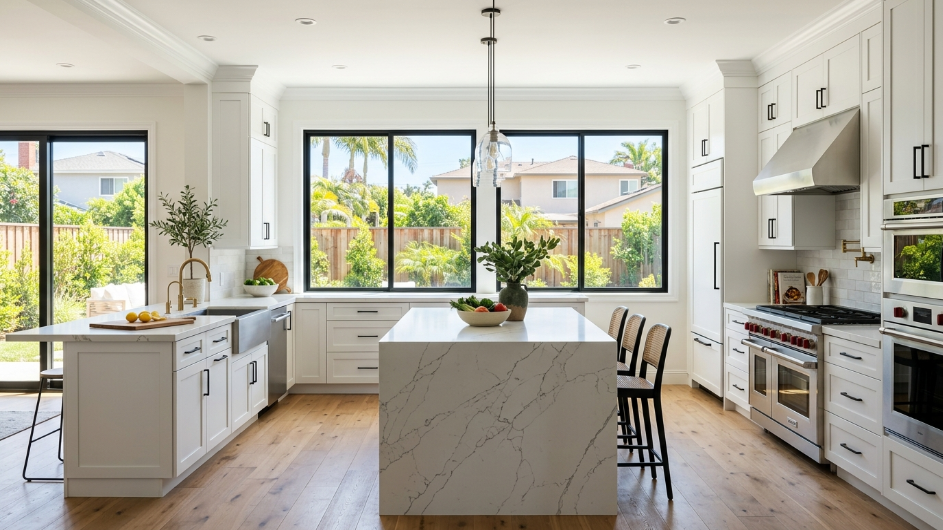
Kitchen renovation spending held at a median of $22,000 in 2025, per NKBA’s U.S. Houzz-sourced data, even as overall remodeling activity cooled slightly from the prior year. Homeowners aren’t necessarily spending less on countertops specifically; they’re being more selective about which material earns that budget line. Three factors tend to come up most often in Lakewood consultations:
- Durability against daily use in a family kitchen, especially in a city where 36.2 percent of households include children under 18
- Maintenance requirements, since many buyers moving into starter homes want a surface that doesn’t need annual sealing
- Resale value, given that the National Association of the Remodeling Industry’s 2025 Remodeling Impact Report puts kitchen renovation cost recovery at around 60 percent at time of sale
Lakewood’s housing stock plays a role here too. The city was built as a postwar planned community on former lima bean and sugar beet fields, with roughly 17,500 tract houses completed by 1953. Many of those original kitchens were designed around smaller appliances and shorter counter runs than today’s layouts call for, which means a countertop replacement frequently comes paired with a modest reconfiguration rather than a full gut renovation.
Comparing the Most Common Materials
Granite
Granite remains the default recommendation for buyers who want a natural stone look with minimal risk. It resists heat well, holds up to daily knife contact better than softer stones, and comes in enough color variation that no two slabs look identical. The tradeoff is porosity. Unsealed or poorly sealed granite can stain from oil, wine, or citrus, so periodic resealing is part of ownership.
Quartz
Engineered quartz is manufactured from crushed stone bound with resin, which makes it non-porous and largely maintenance-free. It won’t need sealing, and manufacturers now produce patterns that mimic marble veining closely enough to fool most house guests. The market research firm Mordor Intelligence projects quartz will grow faster than any other major countertop category through 2033, driven partly by that low-maintenance appeal.
Butcher Block and Laminate
For homeowners working with a tighter budget, laminate has improved considerably in texture and pattern realism over the past decade. Butcher block brings warmth to a kitchen and can be resurfaced by sanding, though it requires regular oiling and isn’t ideal near a sink unless properly sealed.
| Material | Sealing Needed | Heat Resistance | Typical Lifespan |
|---|---|---|---|
| Granite | Yes, periodically | High | 25+ years |
| Quartz | No | Moderate to high | 25+ years |
| Laminate | No | Low | 10-15 years |
| Butcher Block | Yes, with oil | Low to moderate | 15-20 years |
Local Considerations for Lakewood Projects
Lakewood sits just off the I-605, 91, and 405 freeways, near Lakewood Center, one of the oldest enclosed shopping malls in the country when it opened in February 1952. That freeway access matters practically: slab yards and fabrication shops in Long Beach, Cerritos, and Signal Hill are all within a short drive, which keeps delivery timelines shorter than in more remote parts of Los Angeles County.
The city’s median household income reached $119,177 in 2024, according to the U.S. Census Bureau’s American Community Survey, roughly 20 percent higher than the Los Angeles-Long Beach-Anaheim metro average. Homeownership sits at 71.4 percent, and median home values were near $847,800 in 2024. Those numbers help explain why granite and quartz, rather than budget laminate, tend to dominate quote requests in the area. Still, plenty of homeowners in neighborhoods like Carson Park or Imperial Estates West opt for mid-tier quartz specifically because it stretches a renovation budget further than premium natural stone without sacrificing durability.
Zip codes across the city, including 90712, 90713, 90715, and 90807, cover a mix of original 1950s ranch homes and later remodels, so material recommendations vary block by block depending on cabinet height, existing plumbing, and whether a kitchen has been previously updated.
Tips Before Choosing a Countertop
- Bring a cabinet door sample or paint chip when comparing slabs in person, since lighting in a showroom rarely matches home lighting
- Ask about the seam placement before fabrication begins, particularly for islands longer than 8 feet
- Request the exact slab, not just a sample chip, for natural stone since veining and color vary between slabs even within the same quarry lot
- Confirm overhang support requirements if adding a waterfall edge or extended bar seating
- Factor in a measurement and fabrication window of two to four weeks for most stone and quartz orders
What Affects the Final Price
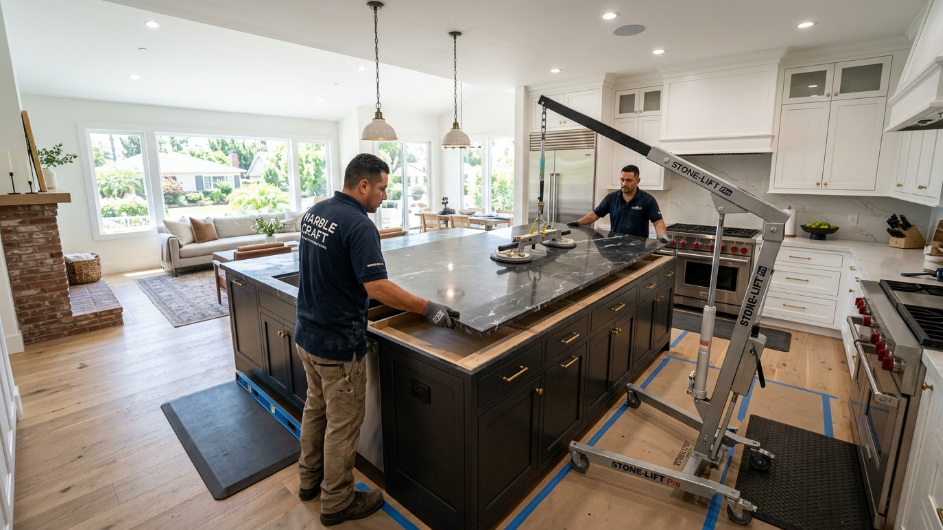
Countertop pricing depends on more variables than most homeowners expect going in. Square footage is the obvious one, but edge profile, thickness, and the number of cutouts for sinks, cooktops, or outlets all factor into the final quote. A straight eased edge on a standard 1.25-inch slab costs less to fabricate than a mitered waterfall edge that wraps down the side of an island.
Material grade matters as much as material type. Granite is sold in tiers, sometimes labeled Level 1 through Level 4 or higher, based on rarity and how far the slab has to travel from the quarry. A commercial-grade granite in a common color runs considerably less per square foot than an exotic slab imported from Brazil or India. Quartz pricing works similarly, with basic solid colors priced lower than patterns designed to replicate marble or quartzite veining.
Labor costs in the greater Los Angeles area, including Lakewood, run somewhat higher than the national average, which tracks with the region’s overall cost of living. Removal and disposal of an old countertop, plumbing disconnection and reconnection for sink fixtures, and any plywood substrate repair under the old surface can each add to a project total. Getting an itemized quote rather than a flat per-square-foot number makes it easier to compare bids accurately.
Maintenance and Long-Term Care
Granite needs resealing on a schedule that depends on the stone’s porosity, typically every one to three years. A simple water test can confirm this: a few drops of water on the surface that bead up mean the sealer is still doing its job, while water that soaks in within a few minutes signals it’s time to reseal. Daily cleaning only requires mild soap and water; harsh acidic cleaners like vinegar or bleach-based products can dull the finish over time.
Quartz asks less of the homeowner day to day. Because the surface is non-porous, spills wipe away without staining, and there’s no sealing schedule to track. The one thing quartz doesn’t tolerate well is direct heat, since the resin binding the stone particles together can discolor or crack if a hot pan sits directly on the surface. A trivet solves that problem permanently.
Laminate holds up fine under normal use but is more vulnerable to scratches and heat damage than either stone option, and unlike quartz or granite, damaged laminate generally can’t be repaired invisibly. Butcher block needs the most hands-on care of the group: periodic sanding to remove scratches, regular mineral oil application, and prompt drying after any exposure to water near the sink area.
Timing a Renovation Around Lakewood’s Housing Stock
With a median home age dating to the late 1950s, plumbing and cabinet layouts in much of Lakewood weren’t designed with today’s larger sinks, pot fillers, or built-in appliance garages in mind. That’s less of an obstacle than it sounds. Fabricators routinely template around existing plumbing rough-ins, and most quartz and granite installations don’t require moving supply lines unless the sink itself is being relocated.
Homes in areas like Lakewood Estates near Del Amo Boulevard, many of which have already seen open-concept remodels or added accessory dwelling units, tend to have countertops that were replaced within the last decade. Older, untouched kitchens elsewhere in the city are where the bulk of new countertop requests originate, often alongside cabinet refacing or a full repaint. Coordinating the countertop template appointment after cabinets are finalized, rather than before, avoids costly remeasurement if cabinet dimensions shift during the project.
Frequently Asked Questions
How long does a countertop installation typically take?
Most kitchen countertop installations take one to two days once the slab has been fabricated, though the fabrication process itself usually adds two to four weeks after final measurements are taken.
Is quartz more expensive than granite?
Pricing overlaps significantly. Entry-level granite can cost less than premium quartz, while mid-tier options in both categories often land in a similar range per square foot.
Do older Lakewood homes need extra prep work for new countertops?
Many 1950s-era cabinets were built to different height and depth standards than modern cabinetry, so a measurement visit before ordering is standard practice to confirm the base cabinets can support the new material.
Can countertops be installed over existing cabinets without replacing them?
In most cases, yes, as long as the cabinet boxes are level and structurally sound. A fabricator typically inspects this during the measurement appointment.
Final Thoughts
Granite and quartz continue to lead the category nationally and locally, though the right choice ultimately depends on budget, maintenance preference, and the specifics of a Lakewood home’s existing layout.