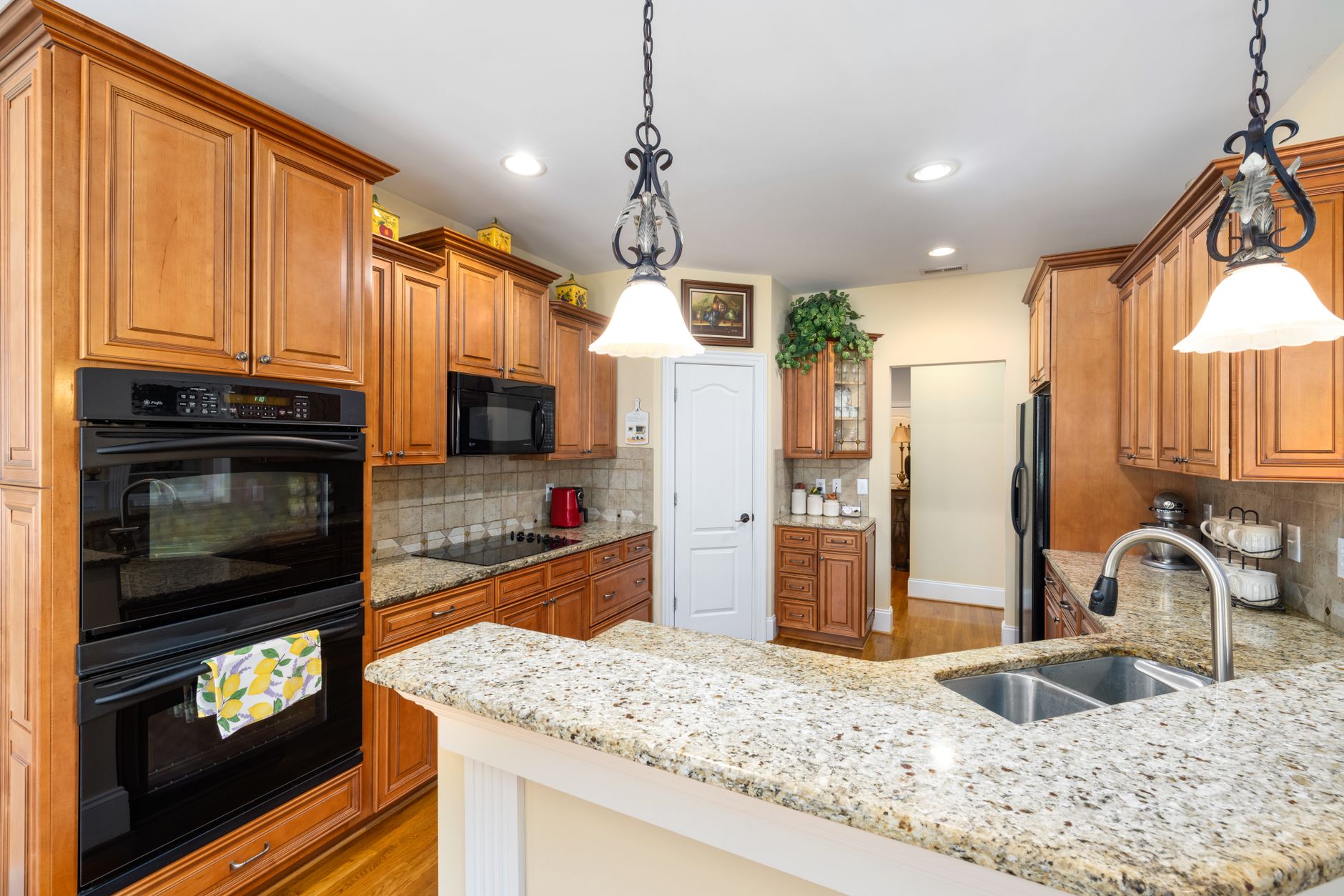
Countertop Replacement in Asheville From Teardown to Final Seam
On
Most people booking a new kitchen surface picture one day of work: the old top comes off, the new one goes on, everybody admires it. The reality runs across two or three visits spread over a fortnight, and the parts that decide whether you are happy in five years happen when nobody is looking at the finished edge.
This is a walk through the whole sequence, in the order it actually happens, with the decisions that matter flagged where they fall.
Why the old surface is coming off matters more than what replaces it
Before anyone measures anything, work out what failed. The answer changes the specification.
A laminate top that has swollen along the sink cutout did not fail because laminate is bad. It failed because water sat in a seam for a long time. If the new surface goes onto the same cabinet deck without dealing with the cause, an expensive slab will sit on a soft substrate.
A tile counter with cracked grout lines is usually a movement problem, not a grout problem. Older houses around the region move seasonally, and a rigid tile field on a flexing base will keep opening up.
Granite that has dulled in one patch has almost always met a cleaner it did not like. That is a resurfacing conversation, not a replacement one, and an honest fabricator will say so before quoting a teardown.
The countertop replacement Asheville homeowners get the most out of is the one where the failure was diagnosed first. It is a ten minute conversation that routinely saves a four figure mistake.
Template day, and why it is not just measuring
Template is the appointment people most often try to skip or rush. It is the one that determines whether the finished job looks made for the room.
A templater arrives after the cabinets are set and level, and after the sink and cooktop are on site or at least fully specified by model. They build a physical or digital pattern of the actual space, not the space as drawn. Walls are rarely square. In houses built before the war around here, a run can be out by a noticeable amount across three metres, and the template is what absorbs that.
Things that get decided on template day:
- Where the seams fall, and which direction the pattern runs across them
- Overhang depth at the sink and at any bar or peninsula
- Edge profile, which is easy to change now and impossible later
- Cutout positions for the sink, taps, soap dispenser and any pop up sockets
- Whether the backsplash is part of the stone order or a separate trade
If your cabinets are not final, template will be wrong. Every reputable shop will refuse to template around a cabinet that is still shimmed or a sink that has not been chosen. That refusal is a good sign.
Choosing the material against the room, not the showroom
Slabs look different in a showroom than in a kitchen. Showroom lighting is bright, neutral and usually overhead. Your kitchen has one window facing a particular direction and probably some warm light under the wall units.
The practical differences between the common choices:
Quartz is engineered, so the pattern is consistent and the surface is non porous. It never needs sealing. It does not love direct heat, so a trivet habit is not optional. It is the low anxiety choice for a busy family kitchen.
Granite is a natural stone, so every slab is genuinely different and you should approve the actual slab, not a sample. It handles heat well. It needs sealing, and how often depends on the specific stone rather than on a general rule.
Quartzite is frequently confused with quartz and behaves nothing like it. It is a natural stone, usually harder than granite, and it is beautiful. It is also the material most likely to surprise you on price, because it is harder to cut.
Marble will etch. That is chemistry, not a defect, and no sealer prevents it. People who love marble accept the patina. People who expect it to stay factory fresh are unhappy within a year.
Butcher block is warm, repairable and cheap to fix if you scorch it. It wants oiling and it does not want a standing puddle at the sink.
For a house with a lot of natural wood, which describes a good share of the older stock in the area, a very cool grey quartz can read as sterile once it is in. Take a sample home and look at it in the evening.
The teardown, which is the messiest hour of the project
Removal is quick and it is where damage happens if the crew is careless.
The old surface has to be separated from the cabinets, and on anything installed with construction adhesive that means prying against boxes that may be forty years old. A good crew scores the caulk line first, disconnects the plumbing properly rather than yanking it, and lifts rather than levers.
Expect the following to be exposed and possibly to need attention:
- The cabinet deck, which may be swollen or delaminated under an old sink
- Wall surface behind the old backsplash, which was never finished properly
- Plumbing that was fine but is now visibly at the end of its life
- Electrical for a cooktop that no longer meets current practice
None of that is the fabricator finding excuses. It is what was hidden. Budget a small contingency for it and the project stays calm.
Seams, and the one question worth asking
Every run longer than a single slab has a seam. Slabs are finite, and a typical kitchen with an island will have at least one, often two.
A seam is not a failure. A seam in the wrong place is.
Good seam placement puts the join somewhere the eye does not travel and the structure supports: near a sink cutout where the run is already interrupted, or over a cabinet partition rather than floating over a dishwasher. Bad placement drops it in the middle of the longest sight line in the room.
The question to ask before the order goes in is simply where the seams will fall, and to have the answer shown on the template drawing rather than described. On a patterned stone, also ask whether the pattern will be matched across the seam. On a busy granite it can be nearly invisible. On a linear quartz it will be obvious if nobody planned it.
Installation day
The slab arrives cut, polished and edged. It is heavy, it is fragile in exactly one direction, and getting it into the house is genuinely the risky part. Narrow mountain driveways and tight interior turns are a real constraint locally, and a fabricator who asks about access before install day is doing their job.
The sequence runs roughly like this. Dry fit first, with the pieces set in place and checked against the walls. Adjustments made on site with a grinder if a wall is out. Then the pieces come up, adhesive goes down, the stone is set, and the seam is drawn together and colour matched.
Plumbing gets reconnected after the adhesive has grabbed, which is usually the same day but not the same hour. If your kitchen is the only sink in the house, plan for it to be out of action into the evening.
The first week
Cure times are the part everyone ignores and then asks about.
Silicone at the wall and at the seam needs time before it is fully water tight. Twenty four to forty eight hours is typical and the product will say. Keep water off the seam and out of the wall joint for that window.
If your stone needs sealing, the first application is usually done at the shop or on site at completion. Test it after a few weeks by leaving a small puddle of water on a horizontal surface for a quarter of an hour. If it darkens the stone, it wants sealing again. If it beads and wipes away clean, leave it alone.
Do not put a hot pan straight down on quartz in the first week or the fifth year. The resin is the part that fails and it does not recover.
What the price is actually made of
Quotes vary far more than material cost alone would explain, because the material is often less than half of it.
The other components are fabrication time, which rises with the number of cutouts and the complexity of the edge profile, template and install labour, the difficulty of access, removal and disposal of the old surface, plumbing disconnection and reconnection, and any substrate repair discovered on teardown.
Two quotes for the same slab can differ substantially and both be honest. Compare what is included rather than the headline number, and specifically check whether removal, disposal and plumbing are in or out.
A short checklist before you commit
- The reason the old surface failed has been identified and addressed
- Cabinets are level and final before template
- You have seen and approved the actual slab if the material is natural stone
- Seam positions are marked on a drawing you have looked at
- Sink and tap are on site or fully specified by model
- Access to the kitchen has been discussed honestly
- Removal, disposal and plumbing are explicitly in or out of the quote
Get those seven settled and the rest of the project is mostly logistics. Leave them vague and the surprises all arrive on the same morning.
Need help in Asheville?
Call (828) 751-8900